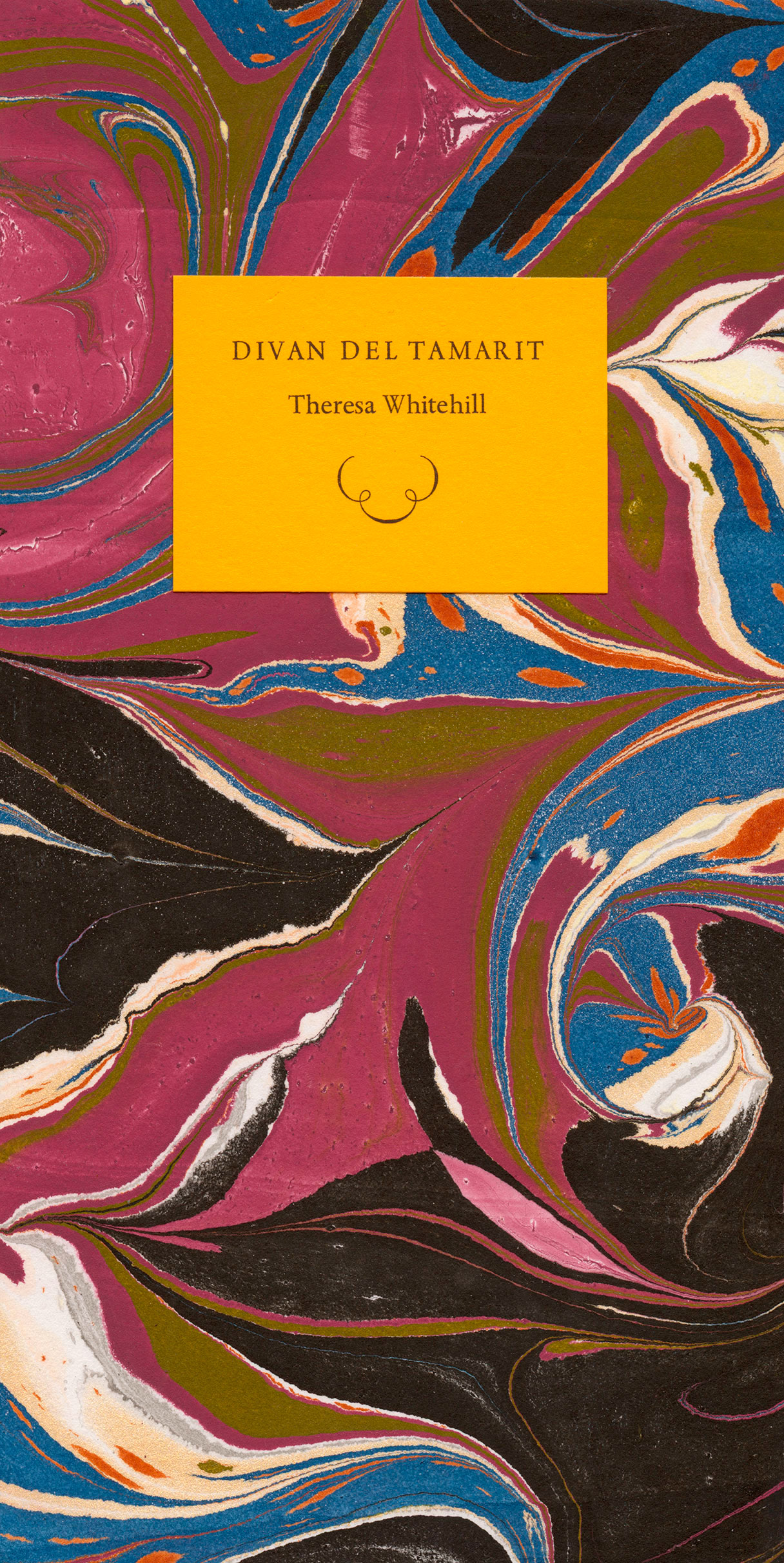
From the colophon on the backside of the publication:
As a cold wind blows through our country do we have the required bravado?
Divan del Tamarit was designed by the Real Lead Saloon team: Sam Duffy, Susan Filter, Jonathan Gerken, Mark Gorenstein, Peter Koch, Jennifer Osgood, Andrea Scharff, and Christopher Stinehour at the CODEX pressroom.
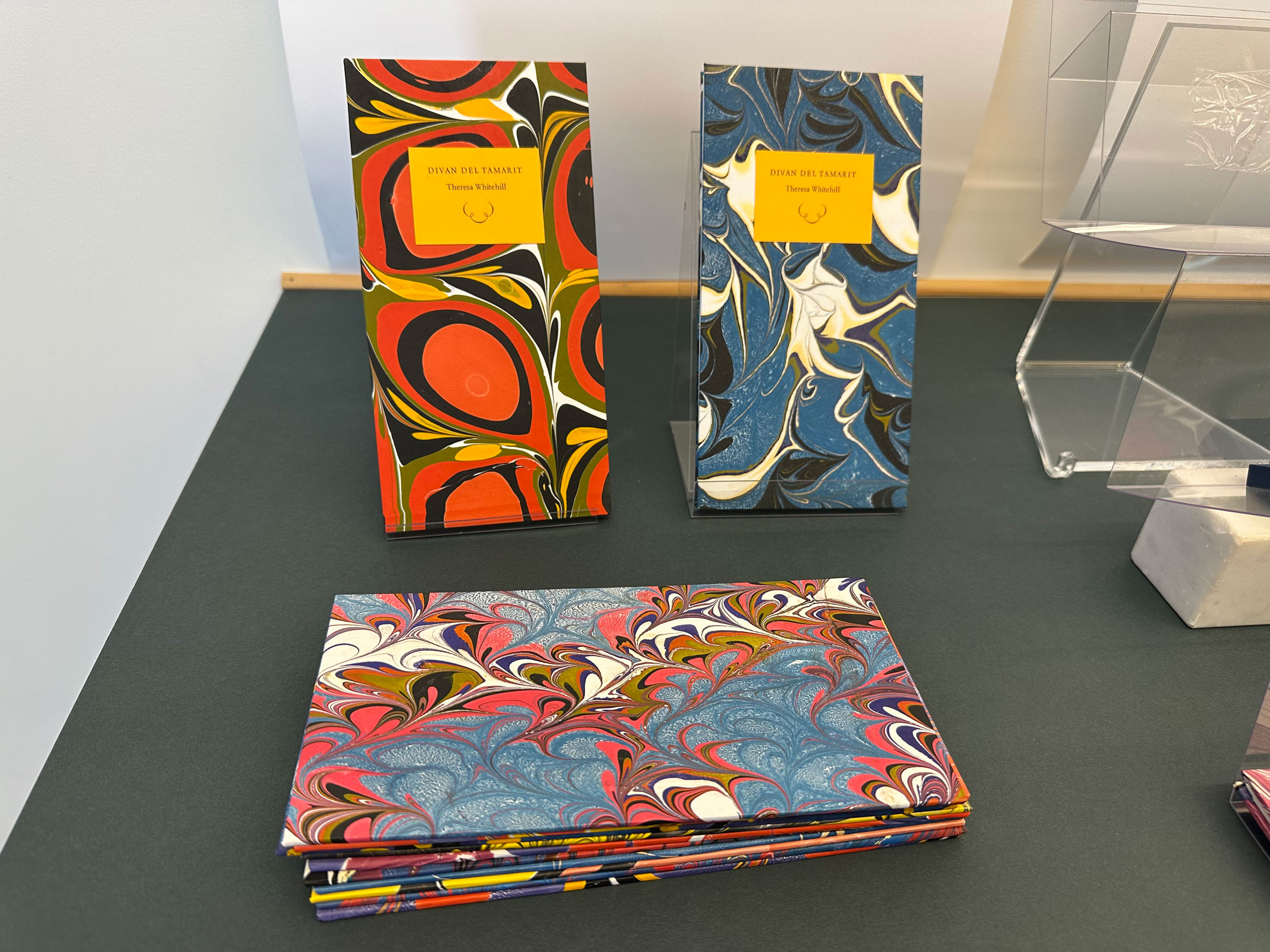
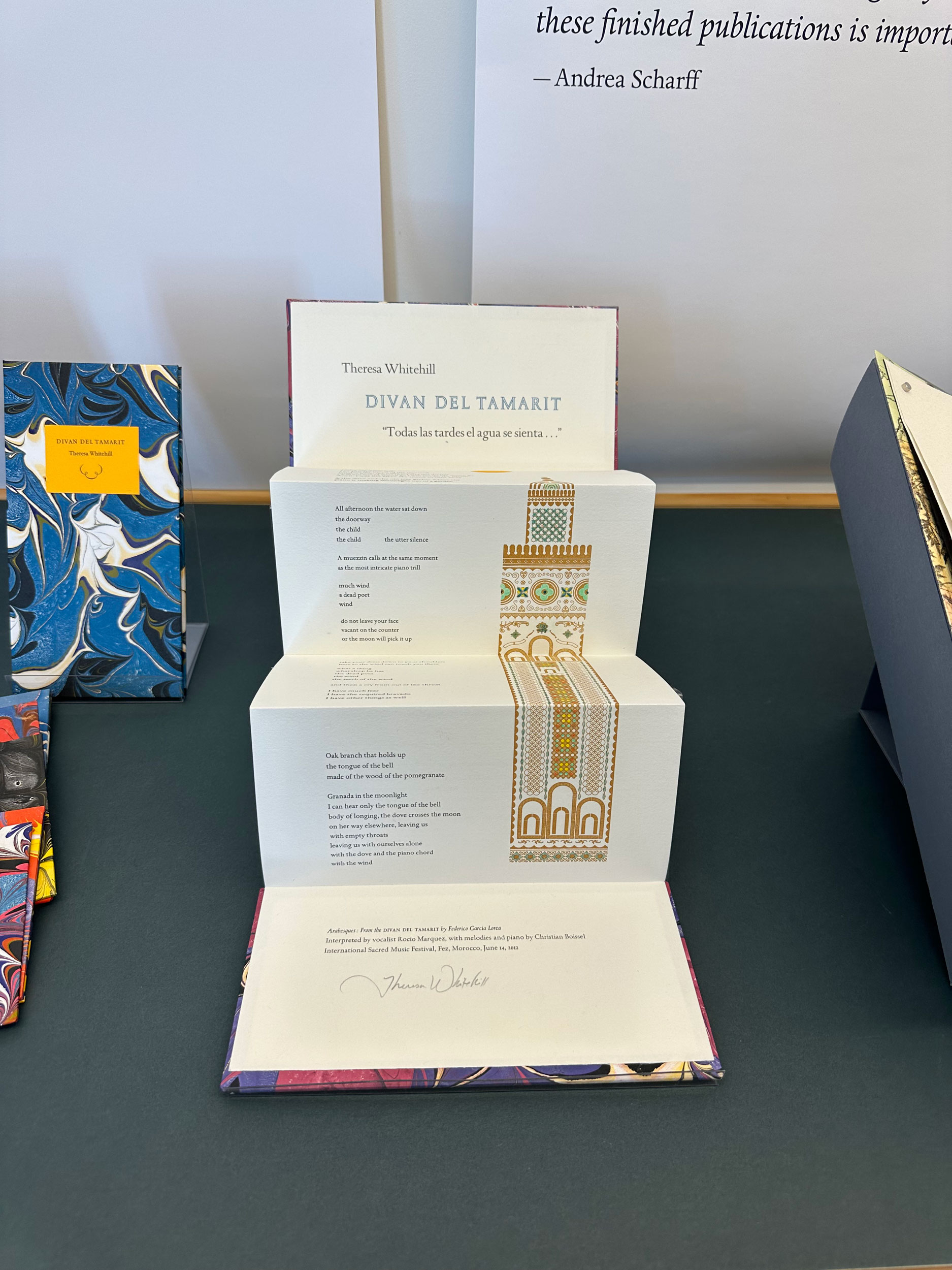
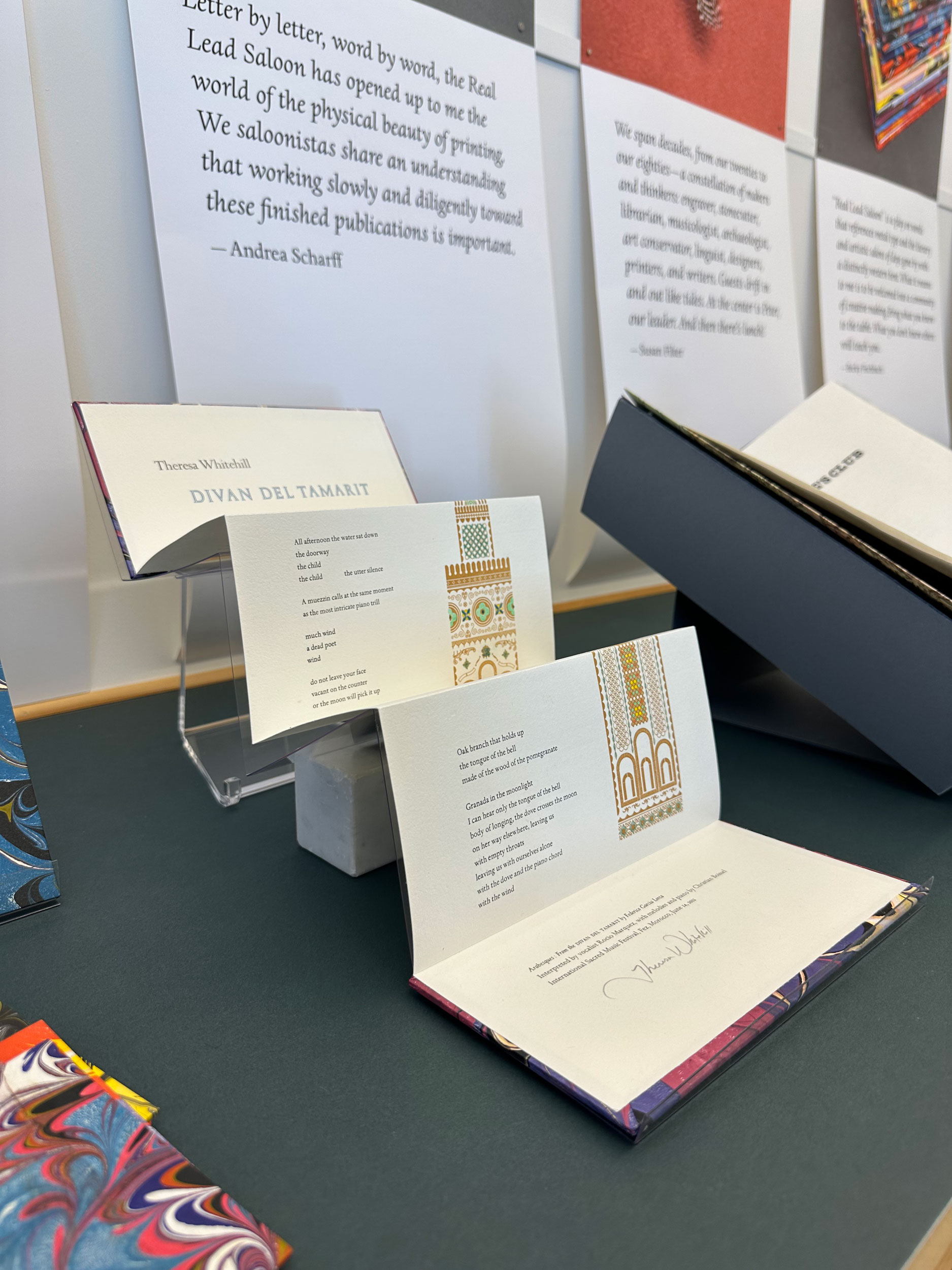
The poem, handset in Monotype Spectrum, was printed on Serpa handmade paper. The typographic illustration was designed by Jennifer Osgood. It was a blast making the Ebru [Turkish marbling] covers at the Old Barn Press.

Divan del Tamarit
A publication of the Real Lead Saloon, Codex Foundation, Berkeley, CA; January 2026
Divan del Tamarit
Book Details
Poem: “Divan del Tamarit,” Theresa Whitehill
Published: January 2026
Publisher: The Real Lead Saloon, Codex Foundation, Berkeley, California
Hard Cover Accordion Fold, 4 1/8” x 8 1/8”
Edition: 46 copies
Page count: 1 (one)
Description of publication: A single page broadside, scored to collapse down in an accordion-fold, and bound between paper over boards, the paper being hand-marbled so that each book has a unique, vibrantly colored cover. The illustration of a minaret was composed of digital type ornaments by Jennifer Osgood, and then hand-colored by the members of the Real Lead Saloon, who hand-set the type, printed the poem and cover label, marbled the papers at the Scharff’s Old Barn Press in Berkeley on a summer afternoon in 2025, covered the boards, and completed the edition in January 2026.
Adapted from the publication exhibit panel: In 2012, Theresa Whitehill traveled to the International Sacred Music Festival in Fez, Morocco. The poem, “Divan del Tamarit” was written while attending a concert there and listening to Spanish flamenco singer Rocio Márquez and Moroccan pianist and composer Christian Boissel perform the poetry of Federico Garcia Lorca’s publication, Divan del Tamarit. Whitehill wrote, “Lorca has perhaps had the most profound influence on my work, being my original inspiration to pursue poetry at the age of nineteen, when I spent four months traveling through France and Spain by bicycle and train, not six months after Francisco Franco died. Márquez’s singing of Lorca’s poetry was true Deep Song, an evocation of duende…”
Background: The inspiration for my poem, Diván del Tamarit, which has been so beautifully and sensitively designed and produced by the Real Lead Saloon, comes from the work of the García Lorca, and specifically, his collection of poems of the same name, in which he paid homage to the Arab-Andalusian, or Moorish, poetics and culture of his native Granada, in Andalusia, Spain.
The word “divan” is from Arabic, meaning a collection of poems. “Tamarit” is the name of the country estate, outside Granada, where Lorca wrote most of the poems between 1931 and 1934. Two years later, in 1936, he was assassinated by Franco’s agents, at the start of the Spanish Civil War. The work was published posthumously in 1940.
In his book, Lorca makes use of Arab literary forms, with 12 Gacelas (or Ghazals), focusing on themes of love—for him, the torment of love and the “terrible presence” of desire—and 9 Casidas (Qasidas), his death poems—exploring dark and wounded landscapes. For the publication event for my poem, in Berkeley in March of 2026, I chose poems that go with these themes and by extension, with Deep Song, Portuguese Fado, and the Blues. The locations of the poems moved back and forth between Spain, Portugal, Morocco, and California, with a bit of Sanskrit thrown in. For a video of the publication event reading, see the link in the left side margin.